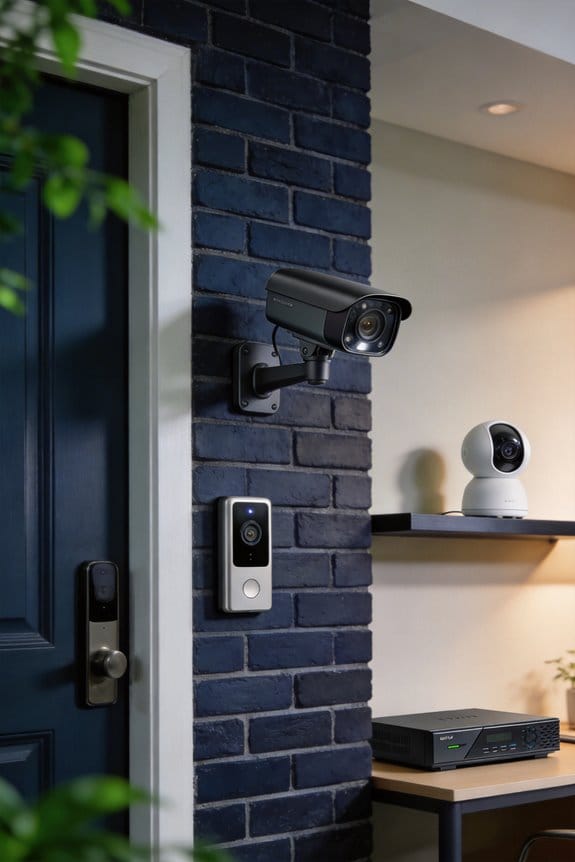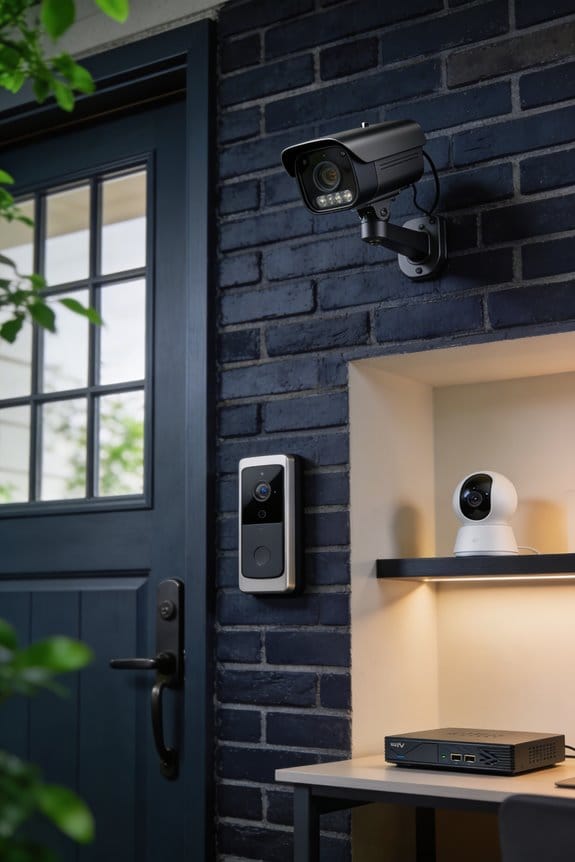


I’ve watched traditional motion sensors evolve into AI-powered behavioral analytics systems that cut false alarms from over 100 per night to just 5 per week, achieving 95-98% accuracy by distinguishing between humans, pets, and vehicles through deep learning algorithms. Unlike basic motion detection that triggers on shadows, branches, or rain, behavioral analytics identifies genuine threats like loitering, zone intrusions, and unusual movement patterns while conserving 60-70% more battery life by recording only significant events. The sections below explain how this technology detects threats motion sensors miss, reduces monitoring costs, and potentially deters criminals.
Key Takeaways
- Traditional motion sensors trigger over 100 false alarms weekly from harmless movements like swaying branches, animals, and shadows.
- AI cameras achieve 95-98% accuracy by using computer vision to distinguish between humans, pets, and vehicles effectively.
- Behavioral analytics detect loitering, intrusion patterns, and unusual activities that basic motion detection completely misses.
- AI systems learn normal activity patterns and differentiate between authorized visitors and potential threats through contextual analysis.
- Smart cameras reduce false alerts by 95% while extending battery life 60-70% by recording only significant events.
Why Motion Sensors Trigger 100+ False Alarms Per Night
Have you ever been woken up in the middle of the night by your motion sensor alerting you to something outside? If you have, you’re not alone. Many homeowners deal with an overwhelming number of false alarms—sometimes over 100 triggers a night. This annoying issue often comes from traditional motion sensors that can’t tell the difference between a wandering cat and a real danger.
These sensors work by simply detecting movement within their range, which creates chaos. Think about it: a breeze can set off alarms if it’s pushing branches, or a passing raccoon could cause your phone to buzz. You might even get alerts from rain, shadows from headlights, or insects crawling across the lens. It’s like a never-ending cycle of notifications that flood your device, leaving you to sift through them just to find out what’s really going on.
So, why does this matter? It can make you question the effectiveness of your security system. You might find yourself disabling alerts altogether, which defeats the entire purpose of having a motion sensor in the first place! Or you might end up wasting hours of your life reviewing footage that doesn’t show anything threatening, just a tree swaying in the wind.
Here’s the trick: consider investing in smarter motion detection technology. Some modern systems can distinguish between different types of movement, helping to cut down on those pesky false alarms. It’s definitely worth looking into if you want to avoid the constant distractions and stay focused on the real security concerns.
In short, traditional motion sensors tend to create more hassle than help due to their inability to differentiate between harmless and dangerous movements. If you’re tired of being on high alert for no good reason, maybe it’s time to rethink your approach to home security. How many more late-night alerts can you handle?
How AI Security Cameras Distinguish People, Pets, and Vehicles

Have you ever wondered why some security cameras seem to know exactly what’s happening while others just go off at the slightest movement? Modern AI security cameras are pretty smart these days. They use advanced technology to figure out what’s what—whether it’s a human, your furry friend, or a passing car.
These cameras rely on computer vision and deep learning to sift through video footage, analyzing each frame like a detective. They look for unique traits that give away what kind of object they’re seeing. Think about it: humans walk on two legs and have a tall profile, while pets are closer to the ground and move around on four legs. Vehicles? Well, they have that distinct boxy shape with wheels that make them easy to spot.
What’s impressive is that this detection system can reach accuracy levels of 95-98% under good conditions, which means fewer false alarms when your dog runs around. No one wants unnecessary alerts buzzing at all hours! Plus, the camera’s built-in learning ability gets better over time. It can even tell the difference between a big dog and someone crouching down. So, you can feel reassured that your camera is paying attention.
Truth is, having a reliable security camera that distinguishes between different types of movement makes life easier. You won’t have to worry about constantly checking your phone to see what triggered an alert. Instead, you can trust that your camera’s got it covered while you enjoy some peace of mind at home.
To sum it up, smart AI security cameras can really help keep an eye on things while reducing the hassle of false alarms. It makes me think, wouldn’t you rather focus on the important stuff in your life rather than worrying about what’s going on outside?
Recommended Products

Ultra High Definition 6K 12MP (4512x2512) SIX TIMES the resolution of 1080P! 32 Channel 12MP NVR Security Camera System with (32) 6K 12MP 4K @ 30FPS Real-Time Weatherproof 135° Diagonal Wide Angle H.265+ PoE IP Microphone Bullet Cameras

Ultra High Definition 4K (3840x2160)FOUR TIMES the resolution of 1080P! 32 Channel 6K 12MP NVR with (32) H.265+ 4K (8MP) @20FPS Weatherproof 135° Wide Angle Microphone Audio & Video PoE IP Bullet Cameras

Ultra High Definition 4K (3840x2160)FOUR TIMES the resolution of 1080P! 32 Channel 6K 12MP NVR with (32) H.265+ 4K (8MP) @20FPS Weatherproof 2.8mm Wide Angle Microphone Audio & Video PoE IP Bullet Cameras
Loitering, Zone Intrusions, and Erratic Behavior: Threats Motion Sensors Miss

Are your motion sensors really keeping you safe? While they do a good job of noting when something moves, they don’t provide the full picture of what that movement might mean. This gap leaves homeowners more exposed to clever security threats than they realize.
One solution to this problem lies in AI-powered behavioral analytics. These systems can spot loitering by monitoring how long objects stick around in certain areas. For example, if someone hangs out too long near your front door, the system can send you alerts that traditional motion detectors wouldn’t catch.
Modern intrusion detection goes above and beyond, learning your usual activity patterns. It can flag strange behaviors like unexpected paths or unauthorized entries into sensitive zones. So, when your delivery person wanders up the walkway, you know it’s safe, but if someone strays into your yard with no reason, you’re alerted to the potential threat.
Honestly, using this kind of technology could make a real difference for your home security. It adds an extra layer of protection that you might not have considered. So, why not explore how these smarter systems could help keep your home safer?
At the end of the day, the aim is to ensure you feel secure in your own space. Are you ready to take a closer look at the security measures you currently have in place?
Recommended Products

【Local & Remote Control】 The home security camera system support local view & control, no need WiFi, true play & plug. For remote control, support dual-band WiFi 2.4GHz/5GHz connectivity. WiFi pro technology offers 100ft installation distance, suitable for indoor/outdoor use.

【All in one 15" LCD monitor】 Wireless PTZ security camera system comes with 15'' LCD screen monitor(Not Touch Screen) which is all-in-one video recording,very easy to setup and no need extra monitor or TV screen. The cameras and NVR monitor are auto-paired during the factory setting. Just need to connect the wireless cameras and NVR with power supply provided for 24/ 7 surveillance purposes.

【Wireless Pro with Extended Range】Equipped with advanced Wireless Pro technology, this 5MP security camera system offers a stable connection with over 100ft range, faster video transmission, and lower latency. Easily connect to WiFi for smooth, reliable monitoring anywhere around your home.
Time-Based Threat Analysis: When Someone Stays Too Long in Frame
Have you ever felt uneasy about someone hanging around your property longer than they should? Maybe it’s that neighbor who seems to linger by your front door or someone looking a little too closely at your windows.
Loitering detection systems can come in handy here. They work by setting time limits that flag any object or person that stays visible to the camera for too long—usually between 30 seconds to several minutes. This is based on what you deem suspicious for your space. By monitoring how long someone hangs around entry points or areas where your valuables are, you can pick up on behavior that might be worth a second look.
Here’s the trick: consider adjusting the time limits based on different zones in your property. For instance, spots like driveways could allow for longer presence times since contractors or delivery folks might be around. But places like entry points or windows should have stricter limits. That way, you’re alerted when someone lingers in places where visitors typically don’t dawdle.
Frankly, this kind of monitoring is super useful for spotting potential threats before they escalate. Think about it—criminals often scout properties for security weaknesses before making their move. Having a system that tracks how long someone stays can help you take action before things go too far.
The best part is that modern systems let you customize these duration thresholds, so you’re in control. No one wants a system that goes off at every small thing. You can set it up to fit your unique security needs instead of dealing with constant false alarms.
Recommended Products

Ultra High Definition 12MP (4000x3000) SIX TIMES the resolution of 1080P! 64 Channel H.265+ 12MP NVR Security Camera System with (32) H.265+ 12MP 4K @ 30fps Real-Time Weatherproof 2.8mm Wide Angle PoE IP Dome Cameras (Built-in Microphone)

32 Channel 12MP NVR with (32) 4K 8MP@25FPS Two-Way Audio Full-Time Color Night Vision Dual Light Active Deterrence 2.8mm Wide Angle PoE Cameras (Built-in Mic and Speaker for 2-Way Talk and built in red/blue almarm dual lights for Smart Active Deterrence)

12.0 Megapixel Full HD Realtime Recording 32 Channel 12MP Commercial-Grade NVR and (32) 8MP 4K Weatherproof Outdoor/Indoor Color Night Vision POE IP Dome Cameras (Built-in microphone and 2.8mm 135° wide angle lens)
Visual Verification: Why Seeing the Threat Changes Everything
When it comes to home security, have you ever wondered why actually seeing what happens is crucial? Knowing something’s going on is one thing, but visual confirmation changes the game. Traditional motion sensors send alerts that often lack the context you need, leaving you to guess if you should check it out or just ignore it.
Imagine a system that gives you a clear visual of what’s happening outside your home. That’s where behavioral analytics comes into play. It lets you see the footage immediately, helping you verify if there’s a real threat or if it’s just a squirrel knocking over your trash can. Without that visual, you’re just taking a shot in the dark, which can be frustrating.
Try this: having professional monitoring services that can view live feeds makes a huge difference. Operators can check in real-time for any suspicious activity and coordinate with law enforcement if there’s a reason to. This level of visual verification takes your security from just reacting to a situation to managing possible threats proactively.
You might think, “What’s the big deal about having footage?” Truth is, recorded videos can provide vital evidence for investigations, insurance claims, and even court cases. They won’t just help you understand an incident better; they can also give you peace of mind, knowing you have that extra layer of protection. Cameras that include behavioral analytics offer much more than standalone motion sensors ever could.
From 100 Alerts Per Night to 5 Per Week: AI Implementation Results
When it comes to home security, dealing with constant false alarms can drive anyone crazy. Have you ever woken up in the middle of the night because your system thought an animal outside was a burglar? It’s a real problem, but here’s some good news: security systems are evolving. By moving from traditional motion detection to AI-powered behavioral analytics, you can expect a drastic reduction in those pesky notifications.
Imagine this: some homeowners have reported their alert frequency dropped from over 100 notifications a night to just 5 a week. That’s a huge 95% cut in unnecessary alarms! So, what’s behind this improvement? AI gets smarter over time. Instead of freaking out at every little movement, it learns to tell the difference between a true threat and harmless triggers like shadows or pets wandering around.
Here’s the trick: the technology focuses on understanding movement patterns and context. It knows your home’s usual activity and can quickly spot unusual behaviors, like someone hanging around or entering a restricted area. This means less wasted battery life on your devices and more time for security teams to handle actual dangers.
Honestly, it’s about making your home security work for you instead of against you. You wouldn’t want to be at the mercy of every little gust of wind or squirrel!
How AI Cameras Save Battery Life, Bandwidth, and Storage Space
Ever wonder why your outdoor security camera runs out of battery so quickly? AI-powered cameras might just be the answer you’ve been looking for. These smart devices only kick into gear and start recording when they notice something truly significant happening, which means you won’t have to stress about constant power drain or excessive data usage like you might with older motion-detection systems.
With this smart battery-saving feature, many of these cameras can last a whopping 60-70% longer between charges compared to traditional options that seem to trigger at every little movement. Imagine not having to constantly charge your camera or worrying about whether it will run out of juice when you really need it.
From what I’ve seen personally, these AI systems really step up when it comes to managing data. They save a ton on bandwidth and storage because they only capture important footage. You’ll end up with less clutter in your video logs, which means you won’t be sifting through hours of nonsense like moving leaves or stray animals.
This also translates to lower cloud storage fees, less network traffic, and quicker access when you need to look at footage. So, why does this matter? It’s all about making your life simpler and more efficient when it comes to security.
The best part is, these cameras are doing all this while still keeping you aware of what’s going on. You won’t have to waste time dealing with irrelevant information; just the real stuff that matters to you.
In a nutshell, AI-powered cameras are a solid choice if you’re looking for a smarter, more efficient way to monitor your home. Are you ready to make the switch to something that actually works for you?
Recommended Products

Ultra High Definition 4K (3840x2160) FOUR TIMES the resolution of 1080P! 64 Channel H.265+ 12MP NVR Commercial-Grade Security Camera System with (48) H.265+ 4K (8MP) @20FPS Weatherproof 2.8mm Wide Angle PoE IP Full-Time Color Night Vision Bullet Cameras (Built-in Microphone)
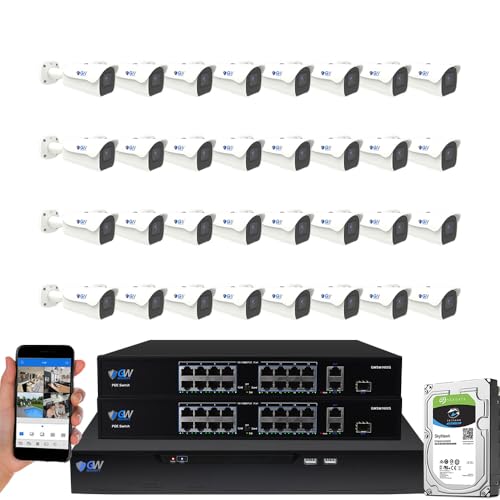
8-Megapixel with 3840x2160 Ultra High Resolution 4K Video & Audio 32 Channel 6K 12MP NVR Security Camera System with (32) 4K (8MP) Weatherproof 2.8-12mm Motorized Zoom H.265+ PoE IP Bullet Camera

64 CHANNEL SECURITY CAMERA SYSTEM: This system has 48pcs 4K/8MP 2.8mm fixed lens PoE IP cameras with built-in microphone, IP67-rated waterproof for indoor and outdoor use. The 4K 64CH NVR of this system comes with 2X 8TB hard drive. it has 8 SATA port to expand to total 80TB storage space.
When Professional Monitoring Turns AI Alerts Into Police Dispatch
Have you ever worried about what might happen to your property when you’re not around? It’s a common concern, and while AI cameras can do a great job of spotting potential threats, they can’t handle everything on their own. That’s where professional monitoring services step in to make a real difference.
When an AI camera spots something like loitering or an unauthorized person trying to enter your property, the first thing that happens is that a professional operator gets an instant alert. They don’t just sit back and wait; they jump into action by reviewing the live video feed to confirm that there’s actually a problem. This personal touch is crucial because it cuts down on those pesky false alarms that automated systems can sometimes miss. After confirming that something’s off, the operator initiates the AI Dispatch protocols, sending important details, video evidence, and your property information straight to the local police.
This system really speeds things up. Unlike traditional alarms, which tend to have sky-high false alarm rates (we’re talking between 90-98%), the combination of AI detection and human oversight means police can respond faster when there’s a real threat.
So, why does this matter? Simply put, faster police response times could mean the difference between catching a criminal in the act or coming home to find your stuff gone. If you’re in the market for a security system, consider a setup that features both AI cameras and professional monitoring services.
Do Criminals Target Homes With AI Cameras Less Often?
Have you ever wondered why some homes seem to fly under the radar of burglars while others get targeted? It’s an unsettling thought for any homeowner. Research suggests that a simple change—having cameras on your property—can significantly deter criminals. In fact, homes with visible cameras can see improvements in safety metrics by anywhere from 50% to 300%. That’s a pretty big deal when you consider how psychology plays into criminal behavior.
Now, let’s get real for a moment. Burglars notice homes that have advanced surveillance systems, especially the ones with AI-enabled cameras. These aren’t just any old devices; criminals see them as serious threats. When they’re casing neighborhoods, they’re actively looking for homes with this kind of technology. If they spot a house equipped with a sophisticated camera network, chances are they’ll steer clear. Why? Because those systems can provide solid evidence, trigger immediate monitoring responses, and crank up the chances of getting caught.
You might be thinking, “But what if I just put up a simple camera?” Truth is, it’s not just the presence of cameras but the capability that counts. Consider this:
- Behavioral analytics: Modern systems can continuously monitor, something that traditional motion detectors simply can’t do.
- Actionable evidence: That means if something does go down, you’ve got proof right there.
When criminals see sophisticated camera setups, they know they’re looking at more than just a deterrent. They’re staring down the reality of being caught in the act, which doesn’t sit well with anyone planning a break-in.
To boost your home’s security, think about enhancing your camera system. The best part is that this approach adds a layer of protection that goes beyond mere deterrence. So, if you’re looking to up your home security, investing in advanced surveillance tools might be the way to go.
In short, putting up those AI-configured cameras won’t just make your home safer; it can keep burglars at bay. Are you ready to take the next step in protecting your home?
What AI Security Cameras Cost vs. Traditional Motion Detection Systems
When you’re thinking about how to keep your home safe, the cost of AI cameras versus traditional motion detection systems is something you really need to consider. It’s all about finding what works best for you and your budget.
AI Camera Pricing Analysis****
AI-powered security cameras usually cost between $150 to $400 each, depending on what kind of features you’re looking for. If you want cool stuff like facial recognition or behavioral analytics, expect to pay on the higher end. Some premium models can go for over $500, but they often come with impressive benefits—like reducing false alarms by up to 95% compared to traditional systems. That means fewer annoying notifications when it picks up harmless movement.
Traditional System Costs Comparison
On the surface, traditional motion detection cameras seem like a steal, priced between $30 and $150. They might look like the budget-friendly choice at first, but watch out! You might find yourself needing extra sensors or multiple cameras to cover blind spots. Plus, if you want professional monitoring, those services can run you an additional $15 to $60 each month. Over time, those little expenses add up and can make traditional systems much more costly than expected.
So, why does this matter? When you’re making a decision about home security, it’s not just about the upfront cost. Think long-term—what will you really pay over the years?
In the end, weigh the initial investment against ongoing costs. What kind of protection gives you peace of mind?
Recommended Products

64 CHANNEL SECURITY CAMERA SYSTEM: This system has 48pcs 4K/8MP 2.8mm fixed lens PoE IP cameras with built-in microphone, IP67-rated waterproof for indoor and outdoor use. The 4K 64CH NVR of this system comes with 2X 8TB hard drive. it has 8 SATA port to expand to total 80TB storage space.

64 CHANNEL SECURITY CAMERA SYSTEM: This system has 48pcs 5MP 2.8mm fixed lens PoE IP cameras with built-in microphone, IP67-rated waterproof for indoor and outdoor use. The 4K 64CH NVR of this system comes with 2X 8TB hard drive. it has 8 SATA port to expand to total 80TB storage space.

12.0 Megapixel Full HD Realtime Recording 32 Channel 6K 12MP NVR NDAA & TAA Compliant Security System with (32) 8MP Weatherproof POE H.265+ 4K Full-time Color Two-Way Audio IP Dome Cameras (Built-in 2.8mm 8MP HD Lens for 135° wide view angle and Built-in Microphone & Speaker for 2-Way Audio)
Frequently Asked Questions
Can AI Cameras Work Offline or Do They Require Internet Connection?
Most AI cameras require internet connection for cloud processing and advanced behavioral analytics. However, I’ve found some models offer limited offline capabilities, storing footage locally while basic motion detection continues functioning despite internet dependency for full AI features.
How Does Weather Like Rain or Snow Affect AI Behavioral Analytics?
Mother Nature’s tantrums don’t fool modern AI systems like they once did. I’ve found that rain effects and snow challenges are minimized since behavioral analytics distinguish weather patterns from actual threats, unlike traditional motion detectors that trigger constantly.
What Happens to My Recorded Footage if the Cloud Service Shuts Down?
If your cloud service shuts down, you’ll face cloud storage risks like losing access to recordings. I recommend checking your provider’s footage retrieval options beforehand and maintaining local backup storage to protect your security videos permanently.
Can Facial Recognition Accidentally Lock Out Family Members or Authorized Visitors?
Let me cut to the chase: facial recognition inaccuracies can occasionally cause hiccups. However, I’ve found that proper setup and regular updates dramatically improve family member identification accuracy, ensuring your loved ones aren’t mistakenly flagged as unknown visitors.
Do AI Cameras Integrate With Existing Alarm Systems and Smart Home Devices?
Yes, I can confirm modern AI cameras offer excellent smart home integration and alarm system compatibility. They’ll seamlessly connect with your existing security infrastructure, allowing coordinated responses when threats are detected, while enabling unified control through single platforms.